


The project materials describe up to 150 MW of total planned power capacity for Wisconsin Rapids, delivered in phases. The project will be supported by new electrical infrastructure built in coordination with the local utility company to ensure reliable power for the site. All of this is being evaluated through Utility Company’s feasibility and planning process leaders.
Any large power user must go through detailed utility studies and planning to ensure that new infrastructure is built to support the load. For Wisconsin Rapids, that includes feasibility reports and a phased interconnection plan with the local utility company. The goal of this process is to deliver the power needed for the project while maintaining reliability for existing customers in Wisconsin Rapids, and the broader service area.
The short answer: the Wisconsin Rapids facility is being designed to use very little water, and the reason comes down to how the cooling system works.
The answer depends on the type of cooling technology being used. Think about the coolant in a truck or tractor engine. It absorbs heat, circulates to the radiator, releases that heat into the air, and flows back through the engine again. The coolant doesn't get used up, it just keeps moving. The same principle applies here. The cooling system planned for the facility circulates water through a sealed loop. That water is added once when the system is first set up, and then it simply cycles, continuously reusing the same water to carry heat out of the building. The heat leaves the building. The water does not.
The proposed Wisconsin Rapids data center is being designed to use a modern closed-loop air-cooling system. Unlike older cooling technologies that rely on continuous water consumption, a closed-loop system circulates water within a sealed network. The system is filled during commissioning and then continuously reuses the same water. This is fundamentally different from older cooling technologies, which rely on evaporation and require water to be continuously replaced, in some cases, millions of gallons per year for a large facility. A closed-loop system has no ongoing consumption like that. As a result, ongoing water consumption is expected to be very low. Because the cooling process does not rely on continuous water withdrawal, day-to-day water use at the facility will come almost entirely from ordinary employee needs — restrooms, a breakroom, and drinking water. The total amount is expected to be comparable to that of a small office building and is not expected to place any meaningful burden on local water resources.
An equally important point for residents near the Wisconsin River: the facility is not expected to discharge cooling water or process water into local waterways. Because the cooling system operates as a closed loop, the water circulating through it is never released. It simply continues cycling within the sealed system. There is no outflow to the river or to local stormwater systems associated with the cooling process.
Many people associate data centers with high water consumption. While that may be true for some older cooling technologies, modern air-cooled facilities are fundamentally different. Their design minimizes water use while maintaining reliable operation year-round. For comparison, many traditional industrial facilities consume substantially more water than a modern air-cooled data center.
This is one of the reasons why closed-loop air cooling has become the preferred solution for many of today's most advanced data centers. It delivers reliable performance while minimizing water use and protecting local resources. We know that water matters in Wisconsin Rapids. Our goal is to ensure residents have accurate information rather than assumptions drawn from older data center models.
This project is being designed to modern standards, and we believe the details will stand up to scrutiny.
As we begin planning the Wisconsin Rapids project, we understand that noise is likely to be one of the questions many residents will have. That is entirely reasonable, and it is something we take seriously from the earliest stages of design.
While the project is still being developed, our approach is already clear: noise impacts will be carefully evaluated, modeled, and addressed throughout the design process.
Before any final design decisions are made, we plan to conduct detailed acoustic modeling with independent experts who specialize in data center noise analysis. Their work will help us understand how sound may travel across the site and surrounding area, and identify any measures needed to ensure compliance with applicable standards.
Noise is not something we intend to evaluate after the project is designed. It is a factor that will influence the design itself.
One advantage of the Wisconsin Rapids site worth highlighting: the nearest home or residence is located more than 1,000 feet from the proposed facility. That distance provides meaningful natural separation and is a significant benefit compared with sites where neighbors are immediately adjacent.
Our goal is not simply to comply with applicable noise ordinances, though we will. Based on the site's characteristics and the mitigation measures built into the project design, we are working toward an outcome where the facility does not materially change the ambient noise environment that nearby residents experience today. That is the standard we are designing to meet.
Several principles are already guiding our planning:
Equipment selection: Modern data centers rely on a wide range of mechanical and electrical equipment. As part of the design process, we will evaluate available technologies and prioritize equipment that delivers strong performance while minimizing noise.
Site layout: The placement of major equipment can significantly affect how sound travels. We will carefully evaluate equipment locations and site configuration to help reduce potential impacts on nearby properties.
Independent review: Acoustic modeling and analysis will be performed by qualified third-party experts with experience evaluating large-scale industrial and technology facilities.
What does a modern data center typically sound like?
Under normal operation, modern data centers are designed to produce a steady, predictable background noise rather than sudden or intermittent noise. Advances in equipment design over the past decade have significantly reduced operating noise levels compared with many traditional industrial facilities.
The final sound levels for the Wisconsin Rapids project will depend on the completed design and the results of independent acoustic studies. Those studies will be shared with regulators as part of the permitting process and will help inform any additional mitigation measures that may be required.
As the project advances, we look forward to discussing these findings with the community and answering questions based on measured data and independent analysis.
Our acoustic analysis evaluates four primary categories of equipment for potential sound impacts: cooling equipment used to remove heat generated by servers; backup generators used during utility outages and periodic testing; electrical infrastructure, including transformers and substations; and building mechanical and HVAC systems. These sources have different sound characteristics and do not all operate at the same time or at maximum output continuously. We evaluate each source separately during the acoustic design process.
Continuous operation does not mean every piece of equipment will operate at its highest sound level 24 hours a day. Sound levels can vary based on equipment demand, site configuration, distance from surrounding properties, temperature, and seasonal conditions. Cooling equipment is expected to be the primary routine sound source, with the highest modeled conditions generally associated with periods of maximum cooling demand, such as very hot summer days. Backup generators are expected to operate only during utility outages and periodic testing. Our acoustic design is also intended to address tonal humming, low-frequency sound, and vibration so that the facility is not intrusive to nearby residences.
Continuous operation does not mean every piece of equipment will operate at its highest sound level 24 hours a day. Sound levels can vary based on equipment demand, site configuration, distance from surrounding properties, temperature, and seasonal conditions. Cooling equipment is expected to be the primary routine sound source, with the highest modeled conditions generally associated with periods of maximum cooling demand, such as very hot summer days. Backup generators are expected to operate only during utility outages and periodic testing. Our acoustic design is also intended to address tonal humming, low-frequency sound, and vibration so that the facility is not intrusive to nearby residences.
Potentially. Earthen berms can function similarly to noise walls and may provide an additional or more visually integrated mitigation option where site space and grading allow. Berms have not yet been incorporated into the acoustic model, but they remain a potential design option. We may also work with landscape architects to incorporate appropriate trees, bushes, and other vegetation. The use of mature trees or any specific landscaping configuration has not yet been finalized.
Yes. The completed acoustic noise model will be part of the project application and will be publicly available.
Final sound levels will depend on the completed design and acoustic modeling. Based on current design assumptions and compliance with applicable City noise limits, modeled sound levels across the river are expected to be comparable to common indoor background sound, such as a refrigerator in a kitchen or a quiet office. Final sound levels will be confirmed through the completed acoustic study.
The proposed data center has a substantially different operating profile from the former paper mill. A data center does not involve the same manufacturing processes, moving industrial machinery, steam releases, or level of daily traffic associated with the former mill. The primary day-to-day sound source is expected to be cooling equipment, while backup generators would operate only during outages and periodic testing. We therefore expect the data center to be a quieter use than the former paper mill.
Daily data center operations are expected to produce modest mechanical noise similar to other light industrial uses, rather than a loud or intrusive ‘industrial’ sound. Major equipment will be located indoors or in screened yards and can be fitted with sound‑attenuating enclosures, barriers, and other suppression measures so that sound levels at property lines comply with Wisconsin Rapids’s noise standards. Backup generators will be enclosed and are expected to run only for short, periodic testing and rare grid outages, not as part of daily operations.
Our acoustic analysis initially evaluates dBA sound levels, which correspond closely with frequencies people typically hear and are commonly used in environmental noise standards. We will also evaluate lower-frequency sound where applicable. The City has restrictions addressing various low-frequency sound levels, and many of the same mitigation measures used to reduce overall noise can also help address low-frequency sound and vibration. Infrasound occurs at frequencies below normal human hearing and, based on the proposed mitigation approach, is not expected to be perceptible to Wisconsin Rapids residents. Specific infrasound measurement distances and detailed measurement methodology will be addressed as the acoustic analysis advances.
We will evaluate relevant existing and planned nearby development as the acoustic design advances. The project must meet applicable noise requirements at the property boundary, and the proposed data center footprint is located within a larger site that provides substantial separation from surrounding properties. Future nearby residential development may be incorporated into the acoustic analysis where appropriate.
Data centers commonly include on‑site backup generators to ensure reliability during grid outages. The Wisconsin Rapids masterplan includes areas reserved for generation and related infrastructure, but specific equipment types, operating patterns, noise controls, and environmental measures will be defined through detailed design and permitting. Those details will be shared with the community as they are developed and reviewed by regulators.
We have evaluated the availability of natural gas for backup or emergency generation. Natural-gas availability may be a limitation at the site. Whether combined-cycle or other natural-gas backup-generation alternatives are appropriate for the project remains under engineering review.
The final generator model numbers, quantity, capacity, and detailed configuration have not yet been finalized. The current design anticipates above-ground generators. Acoustic enclosures and potentially additional noise walls are among the mitigation measures being considered for generator noise. Final equipment selection, generator placement, fuel configuration, and acoustic controls will be established as detailed engineering progresses.
What does 'backup' mean, and when would the generators actually operate?
During normal operation, the data center would receive its electricity from the grid and the backup generators would not be running, aside from periodic testing. If the utility grid experiences an outage, the backup generators would temporarily provide electricity needed to keep critical systems operating, including server and cooling equipment, until normal utility service is restored. Generator testing would be periodic and limited in duration; the final testing schedule has not yet been established.
It is a fair and important question. We want to give you a complete and honest answer, not a marketing message.
The short answer: Under normal operating conditions, a data center produces no industrial emissions. There are no smokestacks, no chemical processes, and nothing being manufactured on site.
Here is what that means in practical terms:
- A data center is essentially a large, climate-controlled building that houses rows of computer servers. Its job is to process and store data, the kind that powers your online banking, medical records, video calls, and everyday digital services.
- The servers run on electricity from the power grid. The building itself does not burn fuel or discharge anything into the air as part of its routine operation.
- The cooling systems that keep the servers at safe operating temperatures use standard mechanical equipment, similar in principle to commercial HVAC systems, and are designed and operated in compliance with all applicable federal, state, and local environmental regulations.
What about the backup generators?
This is where residents often have additional questions, and we want to be direct about it.
Every data center, like hospitals, emergency-service facilities, and many large commercial buildings, uses backup generation to maintain critical systems during a utility outage. The Wisconsin Rapids facility is expected to rely on the electrical grid during normal operations. Backup generators would not operate continuously and would not be used to power construction. Sufficient grid power is available for the construction stage. Once the facility is operational, the generators would generally operate only during utility outages and periodic testing.
To ensure they work when genuinely needed, the generators are tested periodically. The specific testing schedule for the Wisconsin Rapids project will be established during the final design and operational planning process and will be conducted in accordance with applicable regulations and industry standards.
Under the current design, backup generators are expected to be located above ground, although the final configuration remains subject to design development. Acoustic mitigation could include specially designed generator enclosures constructed with sound-absorbing paneling as well as additional noise walls around generator areas where needed. Final generator placement and mitigation measures will be informed by the acoustic model and detailed engineering. Any generator operation and associated emissions will remain subject to applicable environmental regulations and permitting requirements.
To put the project's emissions profile in perspective, it may help to compare it to other industrial uses that could occupy a site like this. Routine daily traffic associated with a warehouse, manufacturing facility, or distribution center of comparable size typically generates substantially greater vehicle-related emissions than a data center operating under normal conditions. Data centers have low daily vehicle traffic because they require relatively few permanent employees on site at any given time. The generators, which are the primary emissions source of note, operate only during outages and periodic testing — not continuously.
As the project advances, we will share more information about generator testing schedules and operational procedures, and we are committed to communicating that information to the community in advance.
We are not telling you that no neighbor will ever notice this facility exists. What we can say is that it will generate less impact than most industrial or manufacturing facilities, and that every aspect of its operation, including backup power systems, is subject to regulatory oversight.
Flood zones, wetlands, and other site limitations are reviewed during site evaluation and the proposed development area is outside the identified flood-risk area. Detailed operating protocols for blizzards, high winds, tornadoes, and extended power outages would be created later in the development process, likely in concert with the future tenant or owner/operator.
Yes. We can prioritize sustainability, efficiency, and environmental performance as part of the operator-selection process. No operator has yet been selected, so these considerations can be evaluated as the project advances.
The proposed substation does not generate electricity. Its purpose is to step down voltage from the transmission line to the voltage required by the data center equipment. Slightly more than three acres are currently reserved for the substation.
Based on the current project plan, all power for the proposed facility is expected to be provided through CWPCo. Based on our current understanding, hydroelectric power generated by CWPCo would be part of the power used to serve the site. We do not operate the utility and cannot speak on CWPCo's behalf regarding its detailed generation or operating decisions.
The current expectation is that uninterruptible power supply (UPS) equipment would be located in electrical rooms or power modules in each building rather than in each individual rack or in one central powerhouse. There are different ways to design the system and this as the most likely arrangement at this stage.
The project is currently in the planning and design phase, and the electrical infrastructure needed to support it is being developed in close coordination with the local utility.
A key point residents should understand: the electrical infrastructure for this project will be designed and built specifically to serve the data center campus. This project does not rely on, connect to, or draw from the existing transmission lines, substations, or regional switchyard infrastructure that currently serves local residents and businesses. The new infrastructure is additive — built for this project, not borrowed from the community.
As with all major infrastructure components, the location, design, and operation of electrical facilities will be carefully reviewed through the development and permitting process. Utilities carefully evaluate future demand, system capacity, and reliability requirements before approving and constructing any necessary upgrades. The objective is to ensure reliable electric service for all customers while minimizing impacts on the surrounding community. Based on discussions with the utility to date, the planned upgrades are not expected to require additional rights-of-way or easements. We are prepared to invest in necessary project-related upgrades subject to final utility arrangements and regulatory requirements.
Electricity rates change over time for many reasons, including fuel costs, infrastructure investments, regulatory decisions, and inflation.
However, the proposed data center will not increase residential electricity rates in Wisconsin Rapids. The data center will pay for the electricity it uses and the infrastructure required to support the project.
We understand that electricity costs are a major concern for many families, and we will continue to share information about the project as plans evolve. We appreciate the opportunity to answer questions and keep the community informed throughout the development process.
The detailed closed-loop system design will be developed during schematic or detailed design and will be required for the building-permit stage. The closed-loop approach is intended to preserve water and avoid evaporative cooling.
Access to river water is not the reason the site was selected. The property is an existing industrial site with infrastructure and characteristics suitable for redevelopment. Its location next to the Wisconsin River reflects the site's historic industrial use rather than a need to use river water for data center cooling.
The project design must comply with applicable environmental rules and regulations, and additional surveys will be conducted where required or appropriate. A number of environmental studies and approvals will be part of the development process to confirm that the project can operate safely. Additional studies may include work related to protection of the Wisconsin River. Detailed design review is expected to include evaluation of site conditions, heat rejection, stormwater, and other environmental considerations as required through permitting.
One of the questions residents may have is whether a data center could place additional pressure on local water resources. It's a fair question, and we want to answer it directly.
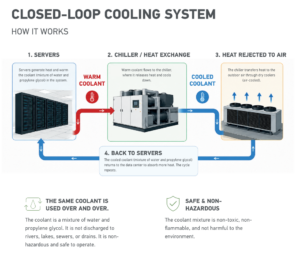
The Wisconsin Rapids facility is being designed to use a modern closed-loop cooling system. A mixture of water and propylene glycol will circulate continuously through sealed piping, carrying heat from equipment inside the data center to outdoor chillers. Heat is then transferred to the outside air while the coolant returns through the system and is reused.
The total coolant volume for the site is currently expected to be approximately 1 to 1.5 million gallons. Importantly, that coolant would not be prepared using Wisconsin Rapids municipal or river water. The water/propylene-glycol mixture would be prepared off-site by the selected supplier or manufacturer, delivered to the site by tanker truck, and pumped directly into the closed-loop system.
The proposed design also uses flanged pipe connections for the main closed-loop lines, which is intended to avoid the need to flush newly installed piping with large quantities of local water before the system is filled.
Once in operation, the coolant remains contained and recirculates within the closed system. It is not intended to be discharged into the Wisconsin River, lakes, stormwater systems, sanitary sewers, or surrounding ground. During maintenance or replacement, coolant would instead be drained directly into tanker trucks and transported off-site for appropriate handling.
Day-to-day municipal water use at the facility would therefore be primarily associated with ordinary employee needs such as restrooms, drinking water, and breakroom use - not cooling.
The data center is expected to use no more than 2,500 gallons of municipal water per day at full build-out. This water will be used for ordinary domestic purposes such as restrooms, drinking water, and breakrooms—not for cooling.
The cooling system is closed-loop and does not rely on continuous municipal water consumption.
The water/propylene-glycol mixture will be prepared at the selected supplier or manufacturer's facility and delivered to Wisconsin Rapids by tanker truck.
The specific supplier has not yet been selected or identified publicly. As a result, the exact preparation location, whether that location will be in Wisconsin, the transportation distance, and the water source used by the supplier are not yet known.
Maintenance intervals will ultimately depend on the operator and equipment requirements. Based on the current engineering approach, the coolant is expected to remain in service for approximately 10 to 15 years before replacement.
When replacement is required, the existing coolant would be drained into tanker trucks and transported off-site, and fresh premixed coolant would be delivered to refill the system.
The number of tanker trucks required for a complete coolant replacement has not yet been determined.
PFAS will not be used in the proposed cooling system. The planned coolant is a mixture of water and propylene glycol. PFAS are commonly referred to as “forever chemicals”; propylene glycol is not a PFAS chemical.
The current project design does not use evaporative cooling or misting for heat rejection. Bala Engineers explained that the proposed cooling system keeps the water/propylene-glycol mixture contained within a closed system and physically separated from the outside air.
The current project design does not use evaporative cooling or misting for heat rejection. The proposed cooling system keeps the water/propylene-glycol mixture contained within a closed system and physically separated from the outside air. Our approach is to use closed-loop, non-evaporative cooling rather than evaporative water cooling.
No cooling-tower blowdown is expected from the proposed design. Blowdown is associated with evaporative cooling systems. Because the Wisconsin Rapids project is being designed with a closed-loop, non-evaporative cooling system, the project is not expected to generate cooling-tower blowdown.
The current project design does not use evaporative cooling or misting for heat rejection. The proposed cooling system keeps the water/propylene-glycol mixture contained within a closed system and physically separated from the outside air. Our approach is to use closed-loop, non-evaporative cooling rather than evaporative water cooling.
We do not expect the project to negatively affect neighboring wells. Cooling would not rely on continuous withdrawal of local groundwater or municipal water, and cooling fluid would remain contained within the closed system rather than being discharged into the ground or the Wisconsin River. If the project were ultimately demonstrated to cause a negative impact on neighboring wells, we would address that impact.
We have been in contact with the Wisconsin Department of Natural Resources. The formal detailed-design environmental review process will proceed as the project advances and applicable permit applications are submitted. DNR review will be part of determining whether the proposed systems comply with applicable environmental requirements.
The proposed data center does not need the former filter plant because the project is not planning to use Wisconsin River water for cooling. If the facility is not needed by the City or another party, it would most likely be demolished. Final disposition will depend on site ownership, engineering, and coordination with relevant parties.
Like an air-conditioning system, the proposed cooling system transfers heat generated inside the facility to the outdoor air. Detailed design will include computational fluid dynamics modeling to evaluate wind patterns, equipment locations, heat generation, and how that heat disperses around the buildings.
The design would be evaluated against applicable engineering standards with the objective of avoiding adverse effects around the buildings, equipment, and surrounding community.
We do not expect the project to affect cranberry growers through interference with water flows. Our civil engineering review indicates that the proposed project is not expected to block creeks or existing flows.
We know water matters in Wisconsin Rapids. This project is being designed to modern standards, and we believe the details will stand up to scrutiny.